| |
ENGINE TECHNOLOGIES MADE EASY!
HERE IS HOW IT WORKS
The most common internal
combustion engines of today can be defined as either four-stroke
or two-stroke cycle. Two-stroke or four-stroke refers to
the number of strokes the piston makes in the cylinder to
complete one power cycle. A stroke is the movement of the
piston in one direction, moving the piston from the top
to the bottom of the cylinder is one stroke. A running internal
combustion engine continually repeats a power cycle called:
intake, compression, power and exhaust. Your automobile
or stern drive engine is most likely a four stroke design.
The majority of existing outboard motors use two stroke
technology. However the current movement in emissions regulations
is pushing the design of current outboards towards the 4
stroke and direct injection two stroke design. Efforts to
build a 4 stroke outboard in the past have been many and
varied, mostly unsuccessful as the design technology and
precision production that can be achieved today were impossible
to achieve then. Resulting motors were bulky and unreliable.
Those motors that were viable were for the most part rejected
by the boating public.
Section Three
DIRECT FUEL INJECTION or DFI
is as the name implies,
a process of injecting a fuel charge directly into the combustion
chamber. Not to be confused with electronic fuel injection
(EFI) or programmed fuel injection into the intake passages
of a four stroke.
|
DIRECT FUEL INJECTION
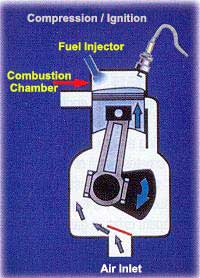
COMPRESSION & IGNITION
DIRECT FUEL INJECTION
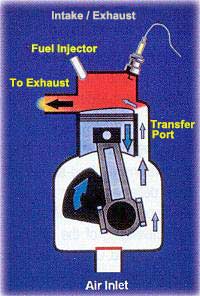
POWER & EXHAUST
|
Up Stroke
- Intake and Compression
On the up stroke the top side
of the piston is compressing only air in the cylinder.
At the same time the bottom side of the piston is pulls
more fresh air into the crankcase past a one way reed valve.
Near the top of the stroke, the direct injector sprays
a plume of fuel directly into the cylinder after the intake
and exhaust ports are closed. This is accomplished in several
ways depending on the engine manufacturer, all serve the
same purpose and have more or less the same components.
That fuel/air mixture is ignited by the spark plug. The
rapidly burning fuel expands and begins forcing the piston
down.
Down Stroke - Power and Exhaust
On the down "power" stroke
the piston is forced toward the crankcase. As it continues
its downward travel it starts first to uncover the exhaust
ports. Exhaust gases begin to rush out of the cylinder.
The intake ports then uncover; fresh air compressed on
the downstroke is then forced into the cylinder and continues
to push the remaining exhaust out of the cylinder. Since
there was only air in the crankcase the cylinder is cleaned
very effectively and readied for the next injection of
fuel.
More on the subject of Direct
Injection, Electronic injection as well as an overview
of the various systems coming soon. Mastertech will attempt
to unravel the claims made by the motor manufacturers.
Stay tuned!!
Back to
TWO STROKE ENGINES, PAGE 2
|
|
|
| |
Please review our Warranty, Returns & Refunds policies before you place an order.
DISCLAIMER
The information provided on these pages is correct to the best of my knowledge, however the MasterTech makes no warranty, express or implied, regarding the use of, results of, or liability created from, application of this data. This information is disseminated in good faith, however MasterTech assumes NO LIABILITY whatsoever in regard to this service. The information, software, products, and services published on this web site may include inaccuracies or typographical errors. Changes are periodically added to the information herein. Mastertech may make improvements to this site at any time. Parts ordered from this website may or may not be in dealer stock at the time of order. Thank you for reading.
|
|