| |
ENGINE TECHNOLOGIES MADE EASY!
HERE IS HOW IT WORKS
The most common internal
combustion engines of today can be defined as either four-stroke
or two-stroke cycle. Two-stroke or four-stroke refers to
the number of strokes the piston makes in the cylinder to
complete one power cycle. A stroke is the movement of the
piston in one direction, moving the piston from the top
to the bottom of the cylinder is one stroke. A running internal
combustion engine continually repeats a power cycle called:
intake, compression, power and exhaust. Your automobile
or stern drive engine is most likely a four stroke design.
The majority of existing outboard motors use two stroke
technology. However the current movement in emissions regulations
is pushing the design of current outboards towards the 4
stroke and direct injection two stroke design. Efforts to
build a 4 stroke outboard in the past have been many and
varied, mostly unsuccessful as the design technology and
precision production that can be achieved today were impossible
to achieve then. Resulting motors were bulky and unreliable.
Those motors that were viable were for the most part rejected
by the boating public.
Section One
FOUR STROKE DEFINED
The first description
reviews the operation of the 4 stroke power cycle. Each
4 stroke image depicts a piston in a cylinder, a spark
plug and 2 valves; one intake, one exhaust. The valves
are held closed by means of a spring and opened by a rotating
eccentric called a camshaft. The camshaft is driven from
the crankshaft by means of gears or a drive belt and timed
to the up and down movement of the piston. To complete
all 4 strokes the crankshaft makes 2 revolutions.
GENERAL OPERATION
|
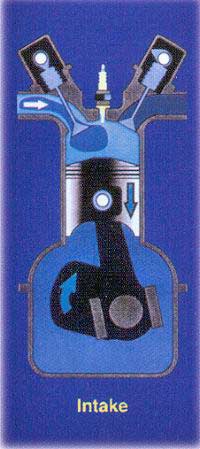 |
Intake Stroke
As the piston is pulled down during
the intake stroke, The camshaft opens the intake valve
and a fresh charge of fuel/air mix is drawn into the cylinder.
The intake valve closes when the piston reaches the bottom
of its downward stroke. |
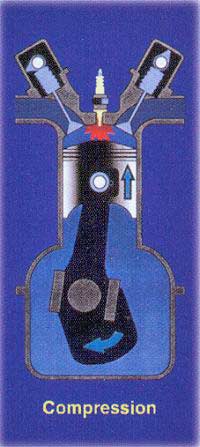 |
Compression Stroke
The piston now begins
to move upward and starts to compress the air/fuel mixture
in the cylinder. Both valves are closed. This continuing
upward motion compresses the mixture to about 100-120
PSI, around 7 or 8 times atmospheric pressure (the compression "ratio").
As the piston reaches the top of the cylinder the spark
plug fires and ignites the compressed mixture. |
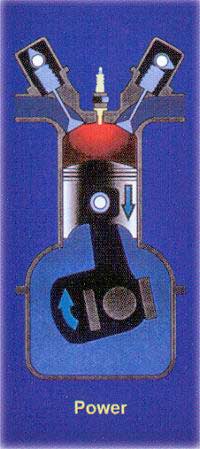 |
Power
Stroke
The fuel air mixture
now BURNS very rapidly, increases in pressure generated
by combustion force the piston downward in the cylinder.
Both valves are still closed. This is the only stroke
that creates power in the 4 stroke cycle. |
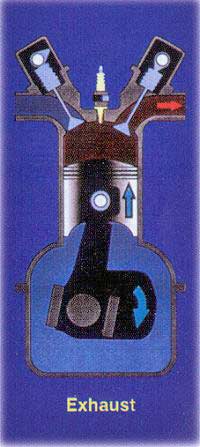 |
Exhaust Stroke
Upon completion of the
power stroke the piston starts to move upward again and
now the exhaust valve starts to open. The continuing upward
movement forces the hot burned gases out past the exhaust
valve. When the piston reaches the top of the cylinder
the exhaust valve closes. The piston starts to go back
down and the cycle repeats itself.
The advantage to the 4 stroke is that
the combustion process is very efficient at varying RPM
ranges with almost no unburned fuel escaping into the
atmosphere. 4 stroke engines also develop significant
torque at low Rpm's. The big drawback is there is only
one power stroke for every 2 revolutions of the crankshaft
so the engine lacks the burst of power experienced with
the 2 stroke engine. Four strokes are more complex as
well as generally much heavier as a result of additional
parts, e.g. camshaft, valve train, balance shafts, etc.
required to complete the power cycle. This additional complexity
does not reduce the engine's reliability. Four strokes
have a proven track record in reliability and dependability.
Next, let's review the two stroke
theory of operation and examine the various types of these
engines and how they work.
TWO STROKE
ENGINES, PAGE 2
|
|
|
| |
Please review our Warranty, Returns & Refunds policies before you place an order.
DISCLAIMER
The information provided on these pages is correct to the best of my knowledge, however the MasterTech makes no warranty, express or implied, regarding the use of, results of, or liability created from, application of this data. This information is disseminated in good faith, however MasterTech assumes NO LIABILITY whatsoever in regard to this service. The information, software, products, and services published on this web site may include inaccuracies or typographical errors. Changes are periodically added to the information herein. Mastertech may make improvements to this site at any time. Parts ordered from this website may or may not be in dealer stock at the time of order. Thank you for reading.
|
|